Market insights
Rattan furniture: Vietnam vs Indonesia in 2026
Indonesia controls the raw rattan; Vietnam controls the workmanship. How the two compare for furniture buyers in 2026.
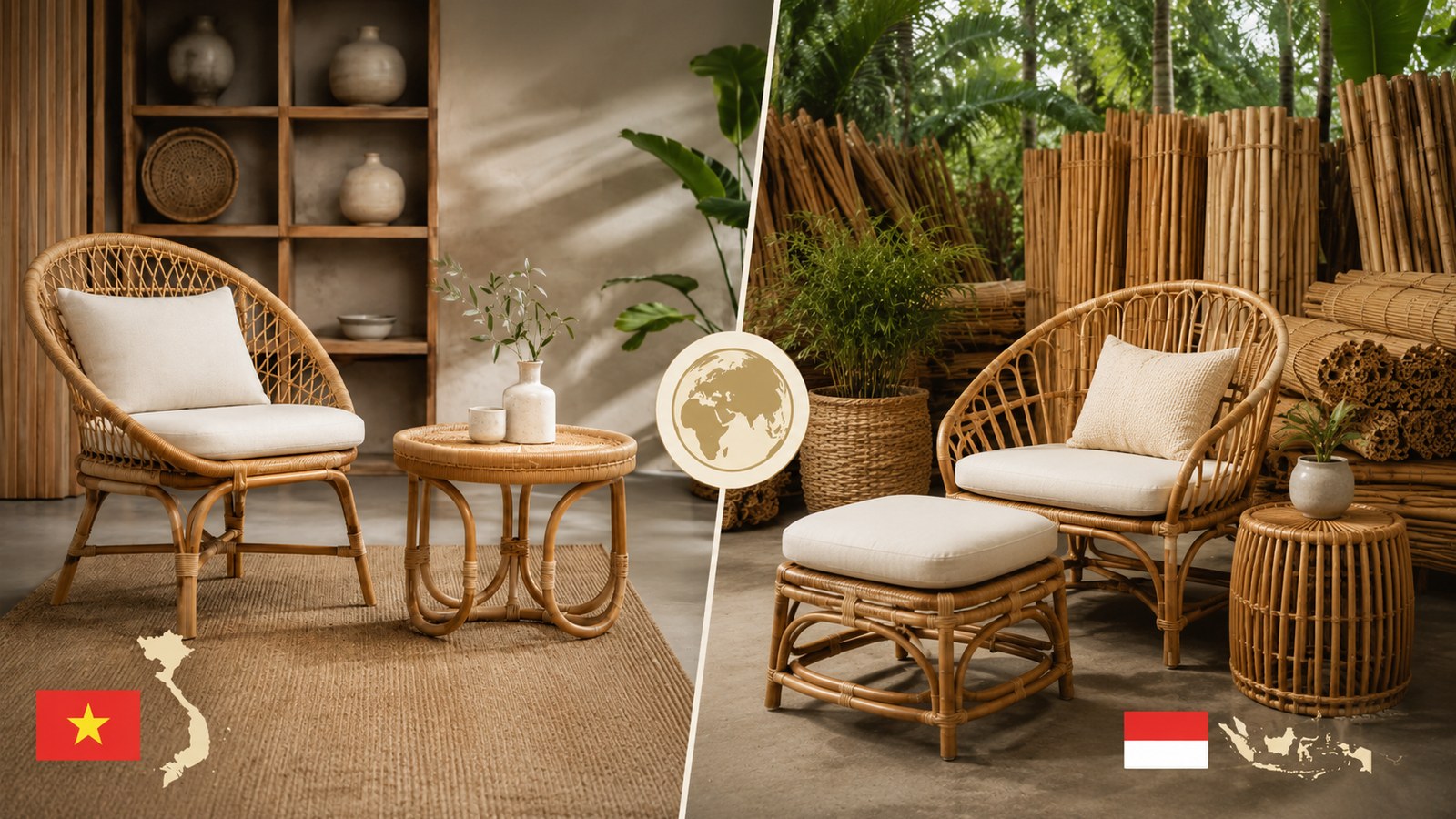
Indonesia historically supplied 80% of the world's raw rattan, then banned raw exports in 2012 to force value-add domestically. That created an opening Vietnam moved into — buying processed Indonesian rattan and rebuilding its own craft furniture industry around it. Raw material origin. Indonesia still controls most rattan species (Calamus, Plectocomia). Vietnam imports semi-processed rattan poles from Indonesia and supplements with domestically grown rattan from the Central Highlands. Cane diameter and quality vary — for premium buyers, ask your Vietnamese supplier about the rattan species and source. Workmanship. Vietnam's rattan furniture cluster is concentrated in Binh Dinh and Phu Yen provinces. The weaving heritage pre-dates the modern furniture industry — many factories employ master weavers who learned the craft as children. Indonesian Cirebon remains the historical centre of expertise but increasingly competes on price, not skill. Lead time. Vietnam-EU is 30–35 days; Indonesia-EU is 28–32 days. Difference negligible. Production lead time depends on factory scale: small Vietnamese workshops 35–60 days, large Indonesian factories 28–45 days. Pricing. Vietnam typically prices 5–10% above Indonesia for equivalent quality, reflecting raw material import cost. Vietnam wins on small-batch (under 1×40HQ) and complex hand-woven designs. Indonesia wins on high-volume standardised collections. Sustainability. FSC-certified rattan exists from both origins. Vietnamese suppliers are increasingly chasing FSC for EU buyers. Confirm chain-of-custody at LOI. Compliance. EU buyers should be aware of CITES Appendix II listings for some Calamus species — your forwarder needs the right paperwork. Design ecosystem. Vietnam's design-aware studios (predominantly in HCMC) have grown rapidly post-2020. For buyers wanting custom collections rather than catalogue picks, Vietnam now matches or exceeds Indonesia on design responsiveness. Verdict: For volume catalogue rattan, Indonesia remains competitive. For mid-volume hand-woven craft and design collaborations, Vietnam wins on combination of skill, FTA tariff advantage (EU buyers especially), and political stability.